
CYANOBACTERIAL ENRICHED VERMICOMPOST IN ASH GOURD (Benincasa hispida) CULTIVATION UNDER REDUCED CHEMICAL FERTILIZERS
Author Name:
AFM Jamal Uddin, Md Zahid Hasan Apu, Oishee Debnath, Nusrat Jahan Nifat and Sushoma Showkat Shanta
Research Area: Agricultural Science
Volume: 14
Issue: 01
Page No: 9–12
Emailed: 0
Total Downloads: 1739
Country:
PDF View:
Research Area: Agricultural Science
Volume: 14
Issue: 01
Page No: 9–12
Emailed: 0
Total Downloads: 1739
Country:
PDF View:
DOI: http://doi.org/10.55706/ijbssr14102
URL: http://www.ijbssr.com/10.55706/ijbssr14102
The experiment was conducted in the Horticultural Farm of Sher-e-Bangla
Agricultural University, Sher-e-Bangla Nagar, Dhaka during the period May 2025
to August 2025 to find out the efficacy of cyanobacteria (Spirulina and Oscillatoria) enriched vermicompost on the growth, yield and quality ash gourd (Benincasa hispida) and to evaluate the nutrient use
efficiency under different treatments, and to determine the economic
feasibility and environmental benefits of using enriched vermicompost. The experiment involved four treatments 100%
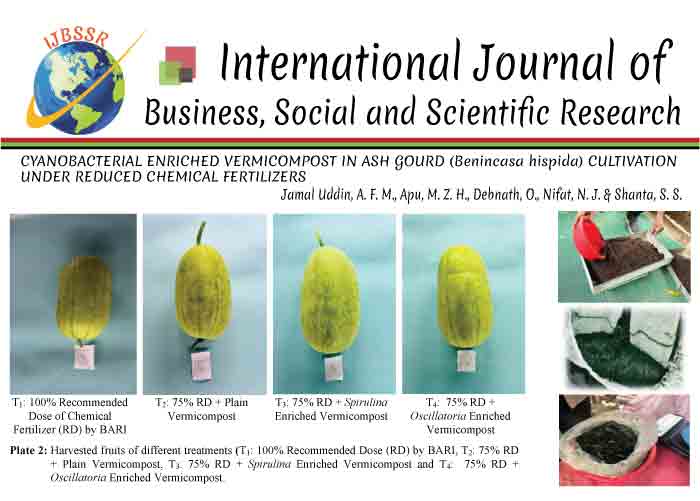
Recommended Dose (RDF) by BARI (T1), 75% RD + Plain Vermicompost (T2),
75% RD + Spirulina Enriched
Vermicompost (T3) and 75% RD + Oscillatoria
Enriched Vermicompost (T4) following Randomized Complete Block
Design (RCBD) with three replications in each plot. The results revealed
a significant variation among the different treatments under study. The application of T4 treatments
showed highest performance in terms of better growth and yield. The yield
obtained from T4 was 47 ton/hectare which was 34.67% higher than the
chemical treatment T1
(34.9 ton/hectare). The application of T2 and T3
treatment both perform poorly over chemical treatment T1. However, T4
treatment exhibits the best result in every parameter. So, the T4
treatment could be the best choice to produce climate resilient ash gourd
production under reduced chemical fertilizers.