
ECONOMIC GROWTH IN BANGLADESH: ASSESSING THE EFFECTS OF FOREIGN DIRECT INVESTMENT, CAPITAL FORMATION AND TRADE
Author Name:
Mitu Rani Roy, Prianka Mandal, Apu Deb Nath and Mohua Akter
Research Area: Economics
Volume: 14
Issue: Issue: 02
Page No: 58–63
Emailed: 0
Total Downloads: 2
Country:
PDF View:
Research Area: Economics
Volume: 14
Issue: Issue: 02
Page No: 58–63
Emailed: 0
Total Downloads: 2
Country:
PDF View:
DOI: http://doi.org/10.55706/ijbssr14207
URL: http://www.ijbssr.com/10.55706/ijbssr14207
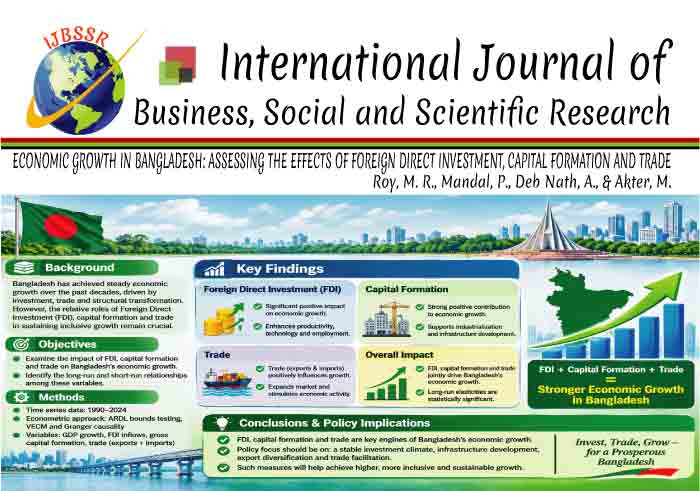
Foreign direct investment (FDI)
was considered an important instrument for structural transformation and
capital formation for any developing country like Bangladesh. This study
examined the effects of FDI, capital formation and trade on economic growth in
Bangladesh and was conducted under annual time series data ranging from 1986 to
2025. GDP
per capita growth (annual %) was used as the dependent variable, while FDI net
inflows, gross capital formation and trade were measured as percentages of GDP.
The data was taken
from World Development Indicators (WDI) and Autoregressive Distributive Lag
Model (ARDL) bounds testing method was applied. The reported bounds test F-statistic exceeded
the upper-bound critical values shown in the study, indicating evidence of a
long-run level relationship. From the study, it was found that FDI had long run significant positive
impact on economic growth although the short-run impact was positive but
insignificant, which clearly depicts gradual materialization of economic growth
from FDI. However, capital formation was positive and significant in both the
short and long-run. The obtained error correction model result was negative and
significant and the diagnostic and stability test results were satisfactory.
Based on the findings of the study, the main recommendations were to promote
feasible FDI promotion policies, ease investing process of foreign companies and establish more convenient
import substitute industries for the economic growth in Bangladesh.