
IMPROVING SUNFLOWER PRODUCTIVITY AND FLORAL QUALITY AS A CUT FLOWER THROUGH MAGNESIUM NUTRITION MANAGEMENT
Author Name:
AFM Jamal Uddin, Prithwi Dhar Oishee, Adiba Nowrin, Oishee Debnath and Sushoma Showkat Shanta
Research Area: Agricultural Science
Volume: 14
Issue: 01
Page No: 34–39
Emailed: 0
Total Downloads: 2186
Country:
PDF View:
Research Area: Agricultural Science
Volume: 14
Issue: 01
Page No: 34–39
Emailed: 0
Total Downloads: 2186
Country:
PDF View:
DOI: http://doi.org/10.55706/ijbssr14106
URL: http://www.ijbssr.com/10.55706/ijbssr14106
The experiment was
carried out at the Horticulture Farm, Sher-e-Bangla Agricultural University,
Dhaka, Bangladesh from October 2025 to January 2026 to study the effect of
Magnesium Sulfate (MgSO4) on the growth, yield, and flower quality of sunflower
(Helianthus annuus L.) as a cut flower. The single factor experiment was laid out in a
randomized complete block design (RCBD) with three replications. Three levels
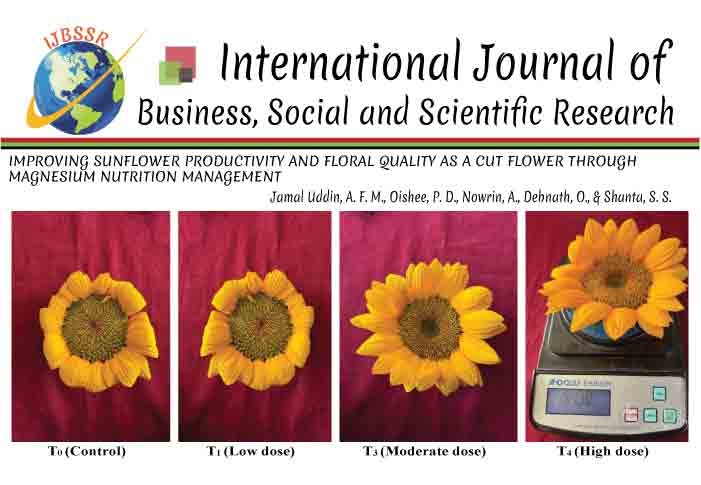
of magnesium sulphate concentration, T0 = Control (only water, no
MgSO4), T1 = Low dose of MgSO4, (1.0 g/plant),
T2 = Moderate dose of MgSO4, (2.0 g/ plant) and T3=High
dose of MgSO4, (3.0 g/plant) were used in this experiment. Data on various growth parameters indicated that
the application of magnesium sulfate (MgSO4) significantly enhanced growth,
yield, and quality attributes of ornamental sunflower. Among the treatments, T3
(3.0 g MgSO4 per plant) exhibited the most pronounced effect, producing the
highest values for leaf area (115.48 cm²), fresh weight with leaves (226.3 g),
number of flowers and buds (11.0), stem diameter (17.2 mm), head diameter
(15.37 cm), single petal area (9.6 cm²), and number of leaves (22.0). In
contrast, the control treatment T₀ (no MgSO₄, only water) recorded the lowest performance, with leaf area
(89.03 cm²), fresh weight with leaves (150.0 g), number of flowers and buds
(8.0), stem diameter (13.3 mm), head diameter (10.77 cm), single petal area
(7.8 cm²), and increased vase life (8.5 days). Therefore, the application of
magnesium sulfate can be considered an effective agronomic practice for
improving growth, yield, flower quality, and market value of sunflower as a cut
flower.