
INFLUENCE OF SUBSTRATE COMPOSITION AND STEM POSITION ON SURVIVAL, ROOTING PERFORMANCE AND EARLY GROWTH OF BOUGAINVILLEA CUTTINGS
Author Name:
AFM Jamal Uddin, D. H. Ashik, A. Nowrin, N. Najiat and & N. J. Nifat
Research Area: Agricultural Science
Volume: 14
Issue: Issue: 02
Page No: 01–07
Emailed: 1
Total Downloads: 682
Country:
PDF View:
Research Area: Agricultural Science
Volume: 14
Issue: Issue: 02
Page No: 01–07
Emailed: 1
Total Downloads: 682
Country:
PDF View:
URL: http://www.ijbssr.com/10.55706/ijbssr14201
An experiment was conducted in the Department of Horticulture at Sher-e-Bangla Agricultural
University in Dhaka, Bangladesh, in 2026. The goal was to study how stem
position and substrate composition affect the survival, rooting physiology, and
early growth of Bougainvillea glabra
cuttings. The research used a Completely Randomized Design (CRD) with three
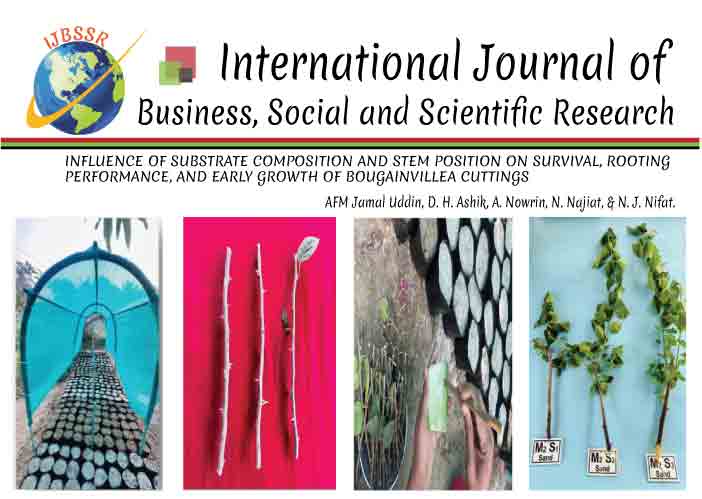
replications and various treatment combinations. Apical, middle, and basal stem
cuttings were planted in different substrates: soil (M₁), sand (M₂), soil +
areca palm fiber (1:1, v/v) (M₃), sand + areca palm fiber (1:1, v/v) (M₄), soil
+ vermicompost (1:1, v/v) (M₅), and sand + vermicompost (1:1, v/v) (M₆). The
results revealed significant differences in days to sprout initiation, days to
root initiation, number of roots, number of leaves and stem diameter. The best overall performance was recorded in
basal cuttings grown in sand plus vermicompost (M₆S₃), which produced the
earliest root and leaf initiation along with the highest number of roots,
highest number of leaves, and largest stem diameter, closely followed by basal
cuttings in sand plus areca palm fiber (M₄S₃) and sand alone (M₂S₃). In
contrast, the poorest performance was observed in apical cuttings grown in soil
alone (M₁S₁), which showed the slowest root and leaf initiation and the lowest
values for root number, leaf number, and stem diameter. The study concluded
that both stem position and substrate composition are important for
successfully propagating Bougainvillea glabra, with basal cuttings
paired with well-aerated, nutrient-rich substrates such as sand plus
vermicompost or sand plus areca palm fiber giving the strongest rooting
physiology and early growth, while apical cuttings in soil consistently gave
the weakest results.