
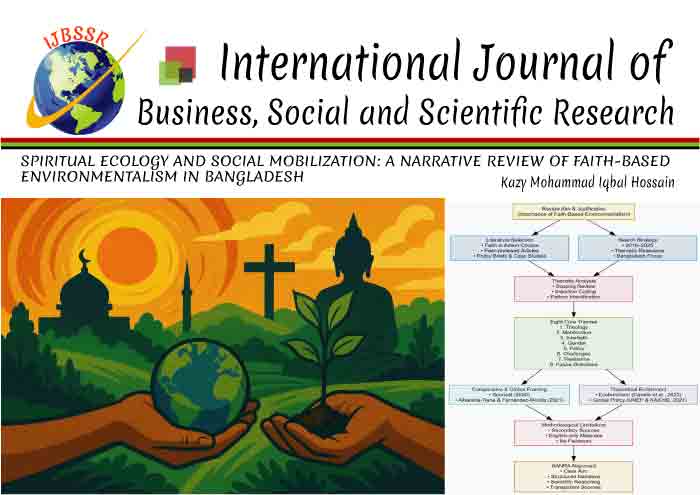
SPIRITUAL ECOLOGY AND SOCIAL MOBILIZATION: A NARRATIVE REVIEW OF FAITH-BASED ENVIRONMENTALISM IN BANGLADESH
Author Name:
Kazy Mohammad Iqbal Hossain
Research Area: Social Science
Volume: 13
Issue: 02
Page No: 51–63
Emailed: 2
Total Downloads: 1094
Country:
PDF View:
Research Area: Social Science
Volume: 13
Issue: 02
Page No: 51–63
Emailed: 2
Total Downloads: 1094
Country:
PDF View:
Bangladesh’s acute ecological vulnerability, coupled with socio-economic constraints, has positioned
faith-based actors as influential yet underexplored stakeholders in environmental governance. This
narrative review synthesizes interdisciplinary literature from 2018 to 2025 to examine how spiritual ethics
and community mobilization intersect in fostering ecological stewardship. The study pursues two primary
objectives: first, to analyze theological foundations shaping environmental ethics within Islamic, Hindu,
and Buddhist traditions; second, to investigate mechanisms through which religious leaders mobilize
communities for climate resilience, with gender dynamics treated as a cross-cutting dimension. Employing
a qualitative synthesis approach, the review organizes evidence into thematic domains encompassing
theology, mobilization, gender, and governance. Findings indicate that doctrines such as Khilafah and
Amanah in Islam, Prakriti in Hinduism, and Ahimsa in Buddhism frame environmental care as a spiritual
obligation. Religious institutions emerge as hubs for ecological education and grassroots activism,
leveraging moral authority to influence behavioral change. Gender-inclusive initiatives enhance social
equity and broaden participation, yet persistent challenges such as resource limitations, epistemic gaps,
and institutional fragmentation constrain scalability. The review concludes that faith-based
environmentalism offers culturally embedded pathways for sustainability and climate adaptation,
necessitating capacity-building, interdisciplinary collaboration, and policy integration. These insights
contribute to global discourses on religion and ecology, underscoring the transformative potential of
spiritual narratives in advancing sustainable development within climate-stressed contexts.