
THE DEVELOPMENT–ENVIRONMENT NEXUS IN BANGLADESH’S RMG SECTOR: ECONOMIC GROWTH AND ENVIRONMENTAL STRESS
Author Name:
Kazy Mohammad Iqbal Hossain
Research Area: Economics
Volume: 14
Issue: 01
Page No: 40–54
Emailed: 2
Total Downloads: 722
Country:
PDF View:
Research Area: Economics
Volume: 14
Issue: 01
Page No: 40–54
Emailed: 2
Total Downloads: 722
Country:
PDF View:
URL: http://www.ijbssr.com/10.55706/ijbssr14107
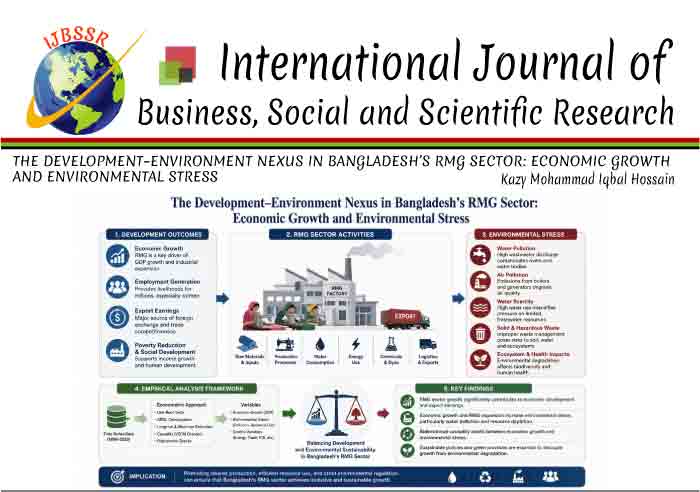
Bangladesh’s ready-made garment (RMG) sector has played a central role
in national economic growth through export expansion, employment generation,
and industrial transformation. However, rapid industrialization has also
intensified environmental degradation and increased ecological vulnerability.
This article examines how such rapid industrial growth has simultaneously
driven economic progress and intensified environmental stress. The study is
based on a systematic review of 80 peer-reviewed and institutional sources
published between 2015 and 2026, supported by secondary data on production,
pollution, and resource use. The findings show that textile production consumes
between 1.5 and 2.5 billion liters of water daily and releases large volumes of
effluent, often inadequately treated, leading to severe river pollution where
biochemical oxygen demand levels reach 200–350 mg/L and dissolved oxygen drops
below 1 mg/L. Air quality in industrial zones remains critically poor, with
PM2.5 concentrations of 65–97 µg/m³, while the sector generates 400,000–577,000
tonnes of textile waste annually, much of it unmanaged. These patterns reveal a
clear imbalance between economic advancement and environmental sustainability,
driven by resource-intensive production, structural constraints, and weak
compliance. The study concludes that without significant intervention,
environmental degradation will pose increasing risks to public health,
ecosystems, and long-term industrial competitiveness. It recommends
strengthening regulatory enforcement, scaling up efficient effluent treatment
and cleaner production technologies, promoting circular economy practices, and
improving environmental governance across supply chains to ensure a more sustainable
and resilient RMG sector.