DOI: http://doi.org/10.55706/ijbssr14202Industrial pollution
of peri-urban wetlands hides an economic transfer. When firms use a wetland's
limited capacity to dilute, oxidise and retain waste instead of treating it,
they avoid treatment costs while nearby communities absorb the environmental
and social losses. This paper treats that transfer as an implicit environmental
subsidy and proposes the SUBSIDY cascade, a seven-stage extension of the
ecosystem-service cascade that adds appropriation, incidence, deferral and
retained private gain. The framework is applied to Mokhosh Beel, a peri-urban
wetland in Gazipur, Bangladesh, through a graded synthesis of site studies and
comparable national evidence. Because avoided treatment cost can be bounded
more reliably than total ecosystem-service loss, a switching-value test is used
to ask how large the unpriced losses would need to be for treatment to pass a
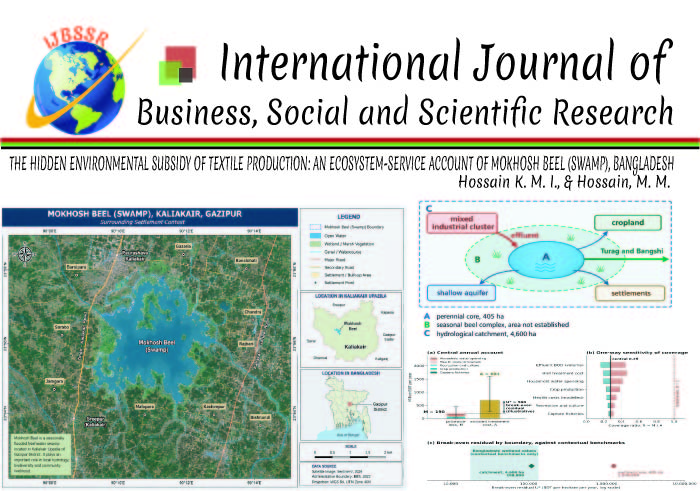
narrow efficiency test. Under central assumptions, which combine reported site
evidence with transferred and assumed parameters, the locally priceable loss is
estimated at about BDT 190 million per year, or 28% of an estimated BDT 691
million in avoided treatment cost. Break-even would require an illustrative
unpriced residual of about BDT 500 million per year (BDT 18 per cubic metre of
effluent, or about BDT 108,800 per hectare across the catchment). This residual
lies within the upper part of the range of Bangladeshi wetland values used as
contextual benchmarks, but it is not a measured loss and it depends strongly on
the spatial boundary and on treatment technology. The case for intervention
therefore rests more securely on uncompensated distributional effects,
irreversibility and cumulative downstream damage than on the efficiency test
alone. The findings support facility-level pollution-load accounting, penalties
linked to avoided treatment cost and detection probability, and paired-season
hydrological and water-quality monitoring.