
ECOLOGICAL CONSEQUENCES OF THE FDMN INFLUX: LOSS OF FLORA AND FAUNA IN UKHIA, COX’S BAZAR
Author Name:
G. M. Sohag
Research Area: Environmental Science
Volume: 14
Issue: 01
Page No: 01–08
Emailed: 0
Total Downloads: 650
Country:
PDF View:
Research Area: Environmental Science
Volume: 14
Issue: 01
Page No: 01–08
Emailed: 0
Total Downloads: 650
Country:
PDF View:
DOI: http://doi.org/10.55706/ijbssr14101
URL: http://www.ijbssr.com/10.55706/ijbssr14101
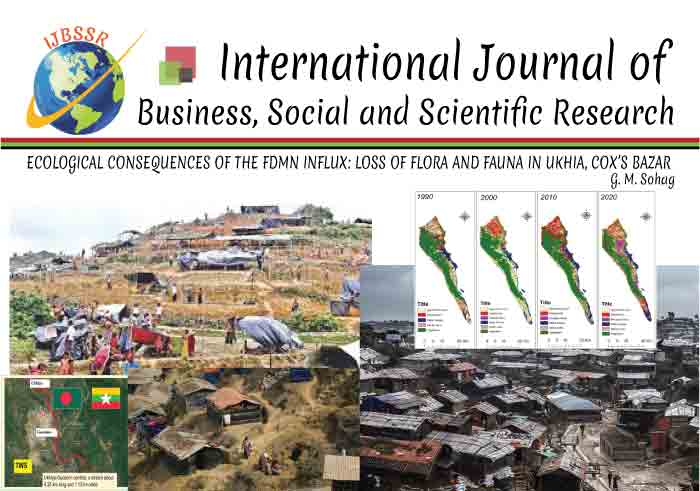
The 2017 influx of
Forcibly Displaced Myanmar Nationals (FDMN) into Cox’s Bazar, Bangladesh,
triggered one of the most rapid and extensive landscape transformations in the
region’s history. This study examines the ecological consequences of the
influx, with particular focus on the loss of flora and fauna in Ukhia Upazila.
Using a mixed-method approach combining satellite imagery analysis, field
observations, and community-based surveys, the research identifies a
substantial decline in forest cover and biodiversity in areas adjacent to
Palong Khali and Raja Palong unions. Indiscriminate extraction of fuelwood and
construction materials for refugee settlements has led to large-scale
deforestation, soil erosion, and habitat fragmentation. Native tree species such
as Rain Tree, Chapalish, Shimul, and Arjun have nearly disappeared, while the
loss of fruit-bearing and medicinal plants has undermined local livelihoods,
food security, and traditional healthcare practices. The resulting ecological
imbalance has not only diminished wildlife populations but also weakened
community resilience and cultural identity. The findings underscore the urgent
need for integrated environmental management and reforestation strategies to
restore biodiversity and mitigate long-term ecological and social impacts in
refugee-hosting areas.