
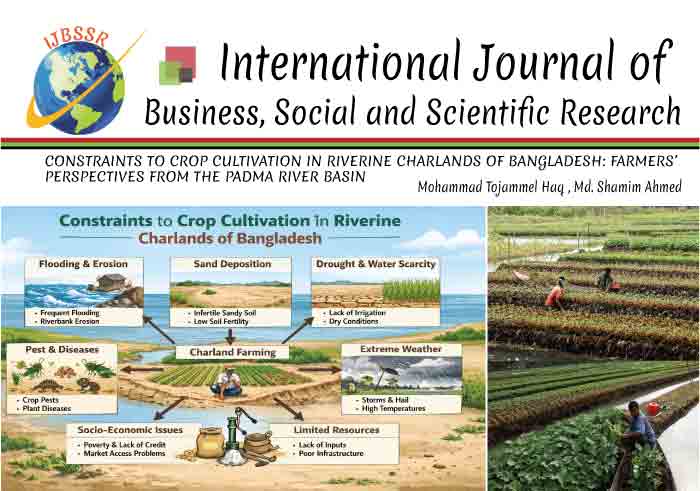
CONSTRAINTS TO CROP CULTIVATION IN RIVERINE CHARLANDS OF BANGLADESH: FARMERS PERSPECTIVES FROM THE PADMA RIVER BASIN
Author Name:
Mohammad Tojammel Haq and Md. Shamim Ahmed
Research Area: Agricultural Science
Volume: 14
Issue: 01
Page No: 13–19
Emailed: 0
Total Downloads: 572
Country:
PDF View:
Research Area: Agricultural Science
Volume: 14
Issue: 01
Page No: 13–19
Emailed: 0
Total Downloads: 572
Country:
PDF View:
DOI: http://doi.org/10.55706/ijbssr14103
URL: http://www.ijbssr.com/10.55706/ijbssr14103
The main purpose of
this study was to assess the constraints to crop cultivation in Bangladesh from
the perspectives of farmers in the charland of the Padma River under Faridpur
district. Data were gathered randomly from 50 farmers out of 774 farmers of selected villages by using a semi-structured interview schedule
during the period from
01 November 2024 to 15 June 2025. Descriptive statistics and the Pearson product-moment correlation coefficient were used for data analysis.
The findings reveal that almost
98.0 percent of the respondents faced medium
constraints to crop cultivation, such as insect and disease attacks, lack
of storehouses, and inadequate training facilities, while 2.0 percent faced low hindrance in crop
cultivation, i.e., degradation of crop cultivars and political disturbance. The
statistical analysis exposed that age, crop cultivation experience, crop
cultivation area, annual family
income, income from crop cultivation, microfinance received, agricultural training exposure, agricultural
extension media contact and input availability had a significant negative
relationship with the hindrance faced by the farmers in crop cultivation, whereas age, crop cultivation experience, cropping area, annual family income, income
from crop cultivation, agricultural training exposure, agricultural extension media contact and input availability had a significant negative relationship with the hindrance of crop cultivation.