
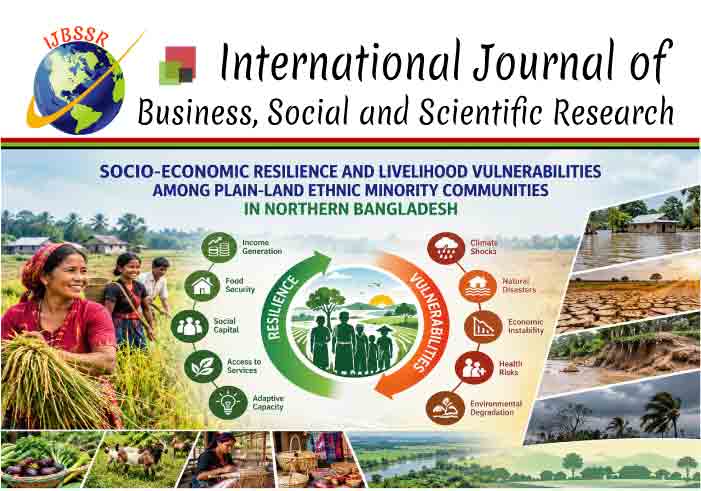
SOCIO-ECONOMIC RESILIENCE AND LIVELIHOOD VULNERABILITIES AMONG PLAIN-LAND ETHNIC MINORITY COMMUNITIES IN NORTHERN BANGLADESH
Author Name:
Dipok Kumar, Md. Shajahan Kabir, Md. Saidur Rahman, Md. Mehedi Hasan Khan and Sambhu Singha
Research Area: Agricultural Economics
Volume: 14
Issue: Issue: 02
Page No: 43–51
Emailed: 0
Total Downloads: 6
Country:
PDF View:
Research Area: Agricultural Economics
Volume: 14
Issue: Issue: 02
Page No: 43–51
Emailed: 0
Total Downloads: 6
Country:
PDF View:
DOI: http://doi.org/10.55706/ijbssr14205
URL: http://www.ijbssr.com/10.55706/ijbssr14205
This study examines livelihood vulnerabilities, gender dynamics within
households, and household food access among plain-land ethnic minority
communities in northern Bangladesh. A cross-sectional mixed-methods study included
300 households selected through non-probability purposive and snowball
sampling, together with 12 focus group discussions (FGDs), six case studies,
and three key-informant interviews (KIIs), across 10 upazilas in five
districts: Sirajganj, Pabna, Natore, Joypurhat, and Naogaon. The analysis
focused on six communities—Santal, Munda, Oraon, Bedia, Bhumij, and Kurmi—using
the Sustainable Livelihoods Framework, the Harvard Analytical Framework, and
the Household Dietary Diversity Score (HDDS). The findings indicate constraints
across human, natural, physical, financial, and social capital. Land
insecurity, dependence on seasonal wage labour, limited productive assets, and
weak institutional linkages were described as barriers to livelihood
resilience, while community networks, sharecropping, and livestock were
reported as coping resources. Based on retrospective self-reported labour-hour
data, the manuscript reports that women contribute more than 60% of labour in
selected field operations and livestock management; the calculation and
weighting procedure should be fully documented to enable independent
verification. Community-specific estimates, including the reported figure of
more than 80% for Oraon women, should be interpreted in light of the sampling design
and the activities measured. The reported mean HDDS values range from 5.20 to
5.60 across communities, with an overall mean of 5.38 (SD = 0.84). These scores
describe household dietary diversity and should not, by themselves, be
interpreted as measures of nutrient adequacy or the proportion of dietary
energy derived from particular food groups. The findings support consideration
of improved land-tenure protection, culturally responsive agricultural
extension, livestock support, gender-responsive financial services, and
targeted social protection. Proposals for a Plain-Land Indigenous Development
Board and a specialized land commission require further assessment of their
legal basis, institutional responsibilities, and feasibility.